
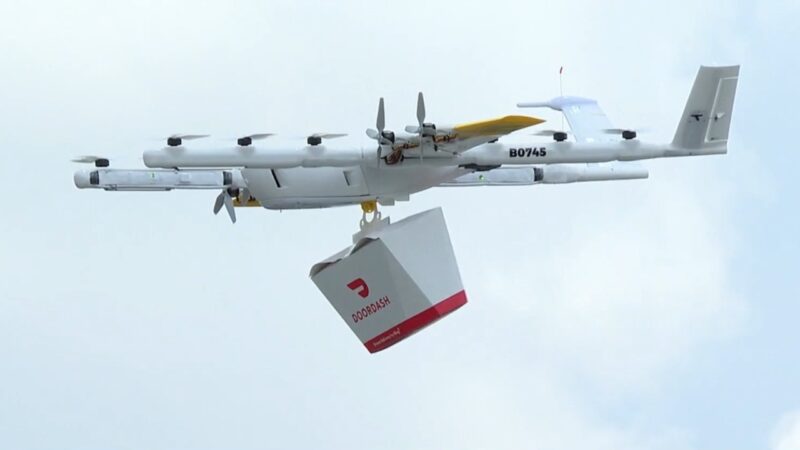
Drone delivery in Charlotte has reached a surprisingly useful stage. The most interesting thing is no longer the drone, but what people are putting underneath it.
Depending on where you live in the Charlotte region, a small autonomous aircraft can now bring over breakfast, lunch, convenience items, and, as of September, home-improvement supplies from Lowe’s.
DoorDash currently surfaces restaurants such as Rhino Market & Deli among its Charlotte drone-delivery options, and the menus stretch well beyond the early “look, a drone brought me food” novelty. Then Lowe’s joined in.
On September 24, Lowe’s launched a drone-delivery pilot from its store in Matthews, North Carolina, just outside Charlotte.
Customers can order more than 100 lightweight home-improvement products through DoorDash and have Wing, the drone company owned by Google parent Alphabet, fly them over in as little as 20 minutes.
The selection includes things such as painter’s tape, screwdrivers, caulk, batteries, soap, and cleaning supplies, according to the Lowe’s announcement.
I think painter’s tape is where drone delivery starts getting genuinely interesting.
Flying the one stupid little thing you forgot in the middle of a project could actually save your afternoon.
Charlotte Has Been Testing This for More Than a Year
Charlotte did not wake up last week and suddenly discover drones carrying hardware.
DoorDash and Wing began residential drone delivery in the city in May 2025. The first operation launched from The Arboretum Shopping Center in southern Charlotte, covering eligible addresses within roughly four miles.
Customers could order through the regular DoorDash app from restaurants including Panera Bread, Curry Junction, Matcha Cafe Maiko, and Joa Korean food.
DoorDash also included its DashMart convenience operation. If an order and address qualified, a drone option appeared in the app. DoorDash outlined the initial rollout when it announced the Charlotte expansion.
The service later expanded in the Charlotte region. Wing opened another hub in Huntersville, and in March 2026 it received FAA approval to extend service at select Charlotte-area sites until 9 p.m.
The drones can now operate after sunset using near-infrared illumination to help their systems see in darker conditions, according to Charlotte Observer reporting. That progression is much more important than another flashy demonstration.
A drone flying one carefully planned route for journalists proves that a drone can fly. Running deliveries from multiple commercial locations, for longer hours, with ordinary customers repeatedly placing orders tells us considerably more.
How the Delivery Actually Works
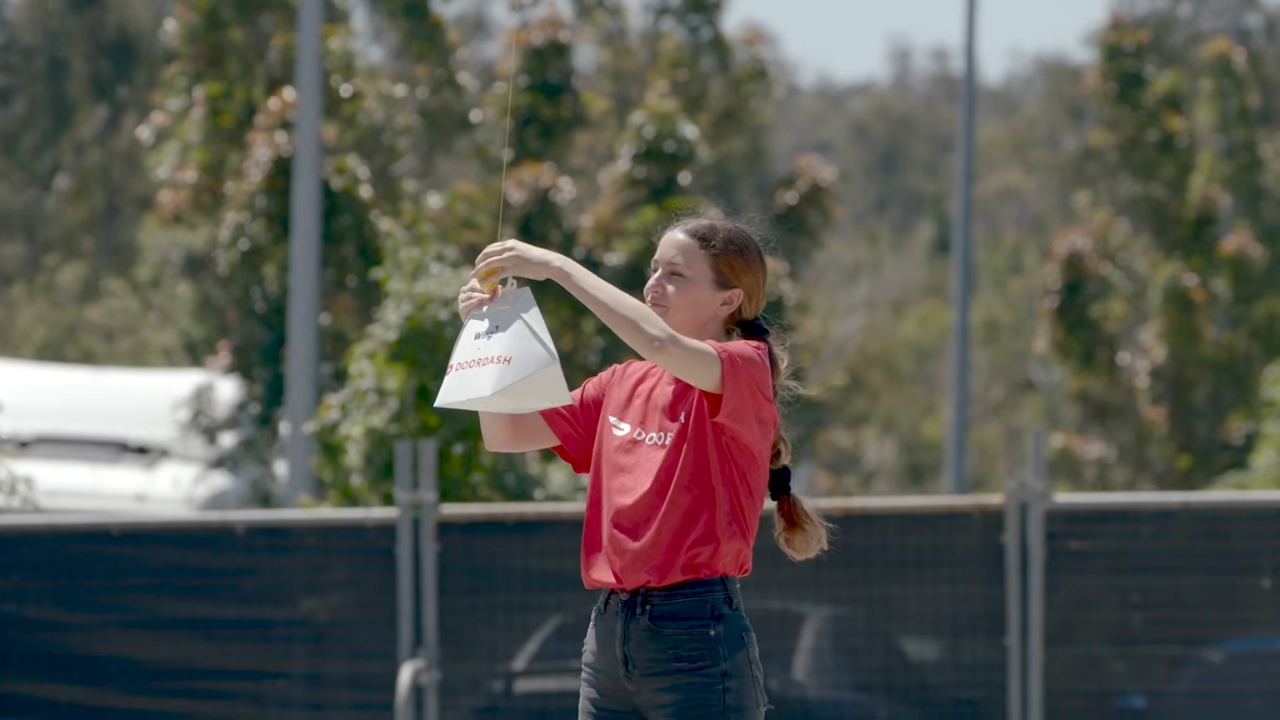
The basic process is refreshingly boring, which I mean as a compliment.
A customer opens DoorDash. If the address, store, and order qualify, drone delivery appears as an option. The order is prepared, transferred to Wing’s system, and attached to the aircraft.
Wing’s drones handle much of the flight automatically. Software selects routes, manages the flight, and coordinates aircraft rather than requiring somebody to stand around steering each drone with a controller.
AI could eventually automate an earlier part of the purchase, too, with shopping bots negotiating prices directly with retailers before the order reaches the delivery service.
Wing says its automation covers drone selection, route planning, flight, and coordination with other aircraft in its overview of the system. Once the drone reaches the destination, it does not land on the driveway next to your car.
It hovers above the delivery area and lowers the package to the ground. That avoids one of the messier parts of autonomous flight: asking a machine to find a safe landing spot among garden furniture, toys, pets, cars and whatever else humans have left outside.
The aircraft used for the Lowe’s pilot currently carry roughly 2.5 pounds per flight. That explains the slightly strange-looking product catalog.
Painter’s tape works. A screwdriver works. A gallon of paint very much does not.
Weight Decides What the Drone Economy Looks Like
The weight restriction is easy to dismiss as a technical detail. It actually shapes the entire service.
Drone delivery currently makes the most sense for things that are:
- Small
- Light
- Needed fairly quickly
- Relatively easy to package
- Annoying enough to fetch yourself
A bagel fits. So does a salad. Painter’s tape fits extremely well. A sheet of plywood has nothing to worry about yet.
Lowe’s May Have Found a Better Use Case Than Lunch
View this post on Instagram
Food is the obvious place to start with fast delivery because people already pay to have meals brought to them.
Home improvement presents a different problem, and I suspect it could be one of the stronger arguments for drones.
Imagine you are halfway through painting a room and run out of tape. The missing item costs a few dollars.
The traditional solution involves stopping everything, cleaning yourself up enough to enter polite society, driving to the store, finding the tape, paying, and driving home again.
That could easily turn a $6 problem into a 40-minute problem.
A drone does not need to transport your entire renovation order. It needs to rescue the project when one small item brings everything to a stop.
Lowe’s is explicitly pitching the pilot around that kind of friction, saying drone delivery is intended for last-minute project essentials and can reach eligible customers in as little as 20 minutes.
For once, I don’t think the marketing department had to work particularly hard to invent the use case.
The Limitations Are Still Very Real
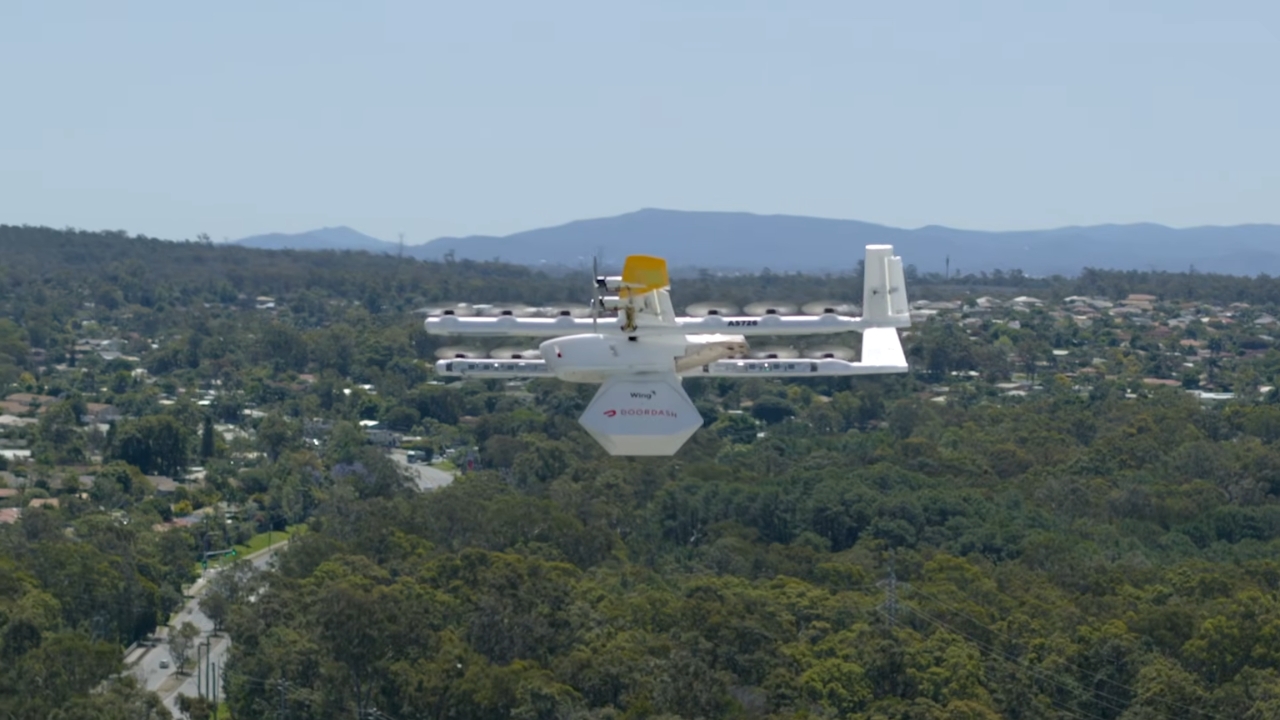
Drone delivery works. That question is largely settled.
Wing says it has completed well over one million commercial deliveries across three continents, and the FAA has regulated its U.S. package-delivery operations under Part 135 since 2019.
Commercial residential delivery by drone is no longer a laboratory experiment.
The harder question is whether it works everywhere, for enough things, at a cost that makes sense. Right now, the answer is no.
Service depends on location. Customers need to live within the operating area of a participating hub.
Their property also needs a suitable delivery zone. DoorDash notes in its drone-delivery guidance that not every address or order qualifies.
Weather matters. Payload matters. Store participation matters.
Local rules for delivery drones can also affect where companies establish launch hubs, even though the FAA controls the airspace. The economics matter enormously, even if customers rarely see that part. Then there is noise.
One drone passing overhead is interesting. Many drones passing overhead every few minutes is an infrastructure question.
Delivery companies will have to prove that neighborhoods tolerate these systems once they become ordinary rather than entertaining.
I have considerably more confidence in the aircraft than I do in our collective enthusiasm for hearing aircraft above our houses all day.
The Really Important Change Is That Drone Delivery Is Getting Boring
Wing has spent years demonstrating that small autonomous aircraft can move lightweight packages quickly. Charlotte now shows the next stage. The service is becoming mundane.
People can order sandwiches. They can get convenience-store products. Papa Johns began a Charlotte drone pilot with Wing in 2026, with Wing detailing the expansion in its Papa Johns announcement.
Papa John’s partners with Alphabet’s Wing to test drone delivery https://t.co/aIo42uyByp
— FOX Business (@FoxBusiness) May 13, 2026
Lowe’s now has more than 100 eligible home-improvement items in Matthews. Wing has also been expanding nationally with Walmart, with plans for a network covering more than 270 Walmart locations.
That is much more significant than another record-setting prototype.
Successful consumer technology tends to become boring.
Netflix demonstrated something similar with its DVD-by-mail service. The red envelopes became part of people’s routines because the service solved an everyday problem without demanding much attention.
Nobody marvels that a card terminal contacts a bank in seconds or that a phone finds the fastest route across a city. The technology disappears behind the useful thing it does.
Drone delivery is not there yet. Plenty of households cannot access it, larger orders remain impractical, and companies still have to prove that the economics hold up as services expand.
Charlotte does make one thing easier to imagine. A drone bringing painter’s tape does not feel like science fiction. It feels like somebody forgot the painter’s tape.
And that, strangely enough, could be a sign that the technology is finally becoming useful.